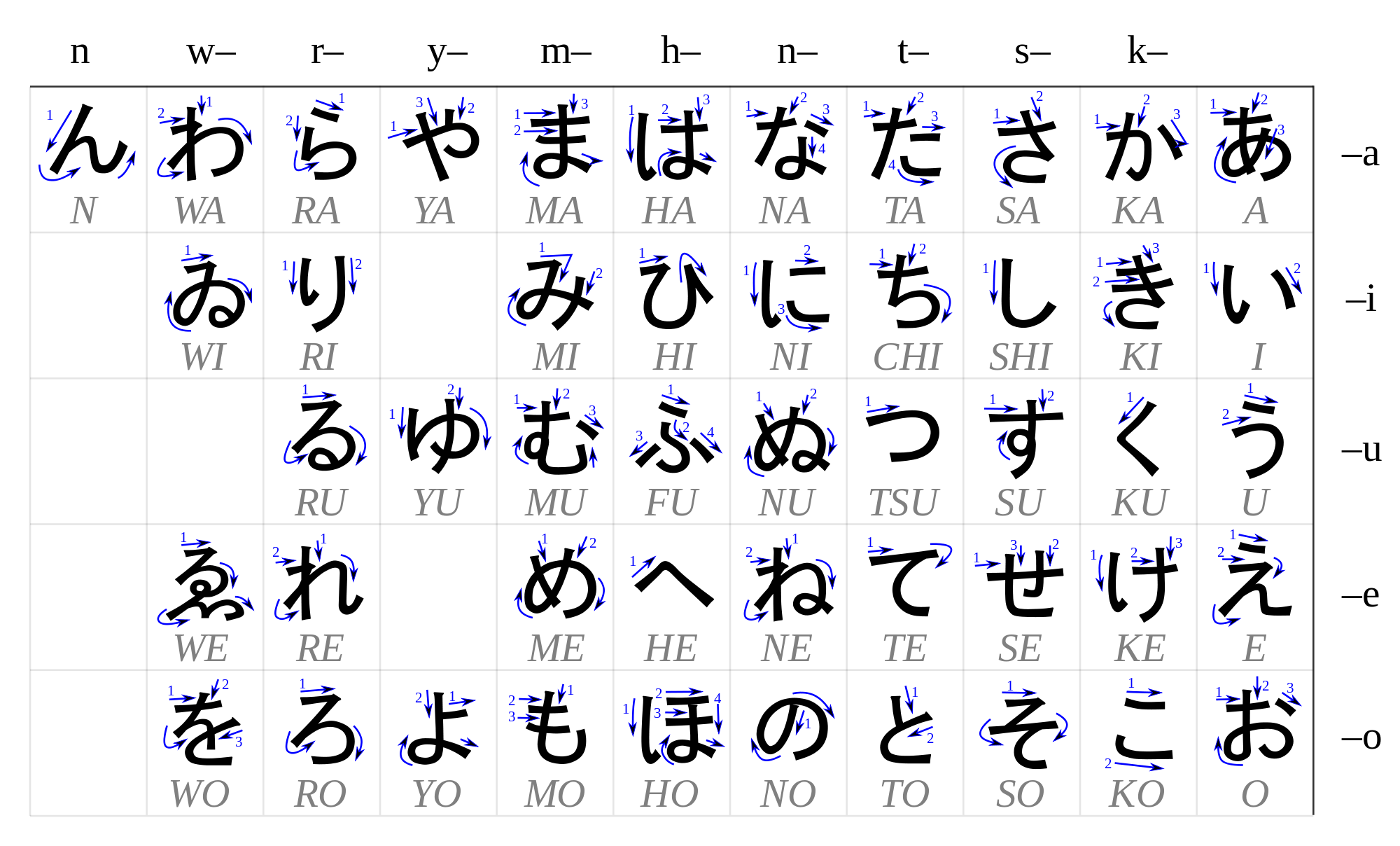
Simple Hiragana
The Hiragana Script is rather easy and only need to learn some simple characters and voila you can form words now.
As mentioned in my previous blog this script has 46 characters and divided by 10 kanas which are respectively Aa, Ka, Sa, Ta, Na, Ha, Ma, Ya, Ra, Wa. Each Kana has 5 characters with some exceptions.
The AA Gyo.
The AA gyo is a subset of the hiragana script and it all has vowels in it. This gyo consist of 5 vowels that are as follows
| Character | Sound |
|---|---|
| あ | A |
| い | I |
| う | U |
| え | E |
| お | O |
The KA Gyo.
The Ka gyo is second subset of Hiragana script, which when added with a ten-ten sounds as GA gyo, The characters and their sounds are as follows:
| Character | Sound | Character | Sound |
|---|---|---|---|
| か | KA | が | GA |
| き | KI | ぎ | GI |
| く | KU | ぐ | GU |
| け | KE | げ | GE |
| こ | KO | ご | GO |
The SA Gyo.
The Sa Gyo is the third subset of the hiragana characters, when added with ten-ten the characters changes to Za sound, There are 2 exceptions in this case though, the there is no sound as SI it is SHI and no sound for ZI it is JI I have marked them with a Star(*).
| Character | Sound | Character | Sound |
|---|---|---|---|
| さ | SA | ざ | ZA |
| し* | SHI | じ* | JI |
| す | SU | ず | ZU |
| せ | SE | ぜ | ZE |
| そ | SO | ぞ | ZO |
* Exceptions
The TA Gyo.
The forth Gyo in this script, adding ten-ten transform them to Da Sounding characters. But it has a few exceptions. like there are no TI or TU sounds rather have CHI and TSU sounds respectively, when ten-ten is added it transforms into JI and ZU, why don't aske me, AFAIK, it is not used anywhere as well, just used the JI and ZU characters from the SA-gyo + Ten-ten and you will probably be correct 99% of the time.
| Character | Sound | Character | Sound |
|---|---|---|---|
| た | TA | だ | DA |
| ち* | CHI | ぢ* | JI |
| つ* | TSU | づ* | ZU |
| て | TE | で | DE |
| と | TO | ど | DO |
* Exceptions
Edit: This reddit post explains the reason for the JI and ZU sound.
The NA Gyo.
The Na gyo is one of the gyos in the hiragana scripts. This gyo do not have either Ten-ten or exceptions. Characters are as follows:
| Character | Sound |
|---|---|
| な | NA |
| に | NI |
| ぬ | NU |
| ね | NE |
| の | NO |
The HA Gyo.
This is the 6th gyo of the hiragana script. This one is a tough nut to crack, this one transforms its sound to BA gyo when Ten-ten is added and PA gyo when Maru is added, only one exception apply that is there is no HU sound rather have a FU sound. Characters are as follows.
| Character | Sound | Character | Sound | Character | Sound |
|---|---|---|---|---|---|
| は | HA | ば | BA | ぱ | PA |
| ひ | HI | び | BI | ぴ | PI |
| ふ* | FU | ぶ | BU | ぷ | PU |
| へ | HE | べ | BE | ぺ | PE |
| ほ | HO | ぼ | BO | ぽ | PO |
* Exceptions
The YA Gyo.
This one is kind of the odd ball here, the Ya gyo is the one of the 2 gyos that has less than 5 characters there are no exceptions tho. Characters are as follows
| Character | Sound |
|---|---|
| や | YA |
| ゆ | YU |
| よ | YO |
The YA Gyo.
The RA gyo is the 9th entry on the gyo list. This has no extra pronunciations or sounds or have exceptions
| Character | Sound |
|---|---|
| ら | RA |
| り | RI |
| る | RU |
| れ | RE |
| ろ | RO |
The WA Gyo.
The WA gyo is the last and 10 gyo of the list this one is the other odd ball that I was talking about, this one got only two characters in it and one of them (WO/O) is only used as a grammar particle. Will explore this one later for now we will focus on the characters itself.
| Character | Sound |
|---|---|
| わ | WA |
| を | WO/O |
This concludes all the gyos in hiragana script, there is one more script that is outside these gyos is the /n/ found ん character. This is the last character of the whole script.
I am aware that the image above is practically unreadable on dark mode, that's why I have a light mode as well. So practicing the stroke order for these characters is of utmost importance.
I have gathered some of my assets for you to practice download and print them
So after this you ain't posting any more lessons. Brih